Week 2
Background knowledge learning
The project is divided into two basic part and will be completed in semester 1 and semester 2 respectively. In semester 1, the model of heat pump based heating system will be designed and simulated on Simulink. As for the semester 2, the designed heating system will be integrated into an existing domestic heating system, the target is to improve the performance of heat pump and beat conventional boiler. The objective will be implemented by designing a controller and adjust its effect by the theory of optimisation.
Based on the requirement that has mentioned above, the necessary demand of background knowledge can be concluded into three aspects, first one is the basic operation principle of Air Source Heat Pump (ASHP) based heating system and its radiator system; second one is the control theory, which is correlated to the ASHP performance, hence we are interested in a new advanced control theory named Inverse Dynamics Energy Assessment and Simulation (IDEAS); the third one is the optimisation of the whole system, which could using the optimum start algorithm and the Genetic Algorithm (GA) optimisation method etc.
For this week, the learning was focus on the operation principle of ASHP based heating system.
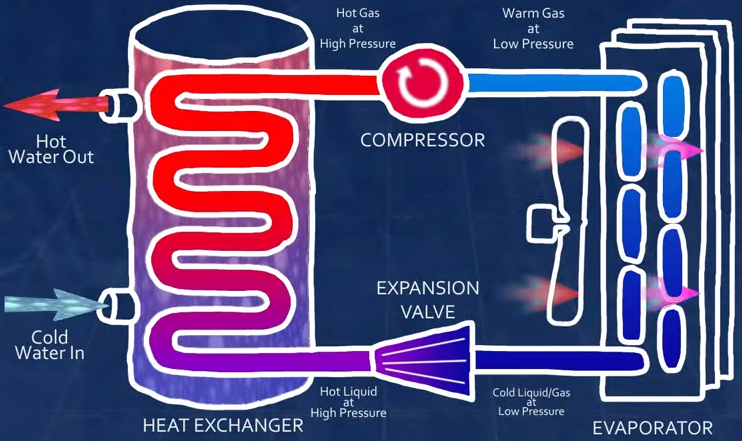
Air Source heat pump (ASHP) used to transfer heat from one side to another, based on substance
of refrigerant and vapour compression cycle. The basic operating principles are explained as
Figure 1 shown. It consists of four stages during one cycle; fi rstly, the refrigerant is in a low
pressure, cold and liquid state, which will extract heat from the outside air as the existence
of temperature diff erence, this process could be amplified by increasing the rotation rate of
fans. Secondly, the absorbed heat turns refrigerant into warm, low pressure vapour, followed
by through the compressor results of high pressure and high temperature gas. Thirdly, the
heat will be exchanged to water at the condenser, which is connected with several water-filled
radiators. Fourthly, the refrigerant passes the expansion valve results of low pressure and low
temperature gas, which is ready for next cycle and able to absorb heat again.
Based on previous research, the Coefficient Of Performance for ASHP could achieve 3 faced with conventional boiler is 100% efficiency. Hence, the COP is a reference quantity to describe the eff iciency of system, which can also be calculated via the total electricity used by ASHP divided by total heat dissipated to the dwelling.
Gavin Murphy states that two regression models are included in ASHP, which could calculates
COP and maximum output of heat ( ASHP; max). Meanwhile, both the calculations could
be expressed in a 2nd order polynomial equation with two variables; external temperature of
air (To) and return temperature from radiator (Treturn). The calculated equations are shown
in Equation 1 and Equation 2.

The coefficient of these two equations is shown below:
Based on this principle and calculations, the ASHP model could be implemented on MATLAB with the function of Simulink. However, there exists another important component of the heating system, radiator system. Radiator system is relative to the heat transfer from the ASHP to the room air, which has significant effect on the overall performance of the system and will be researched for next week.